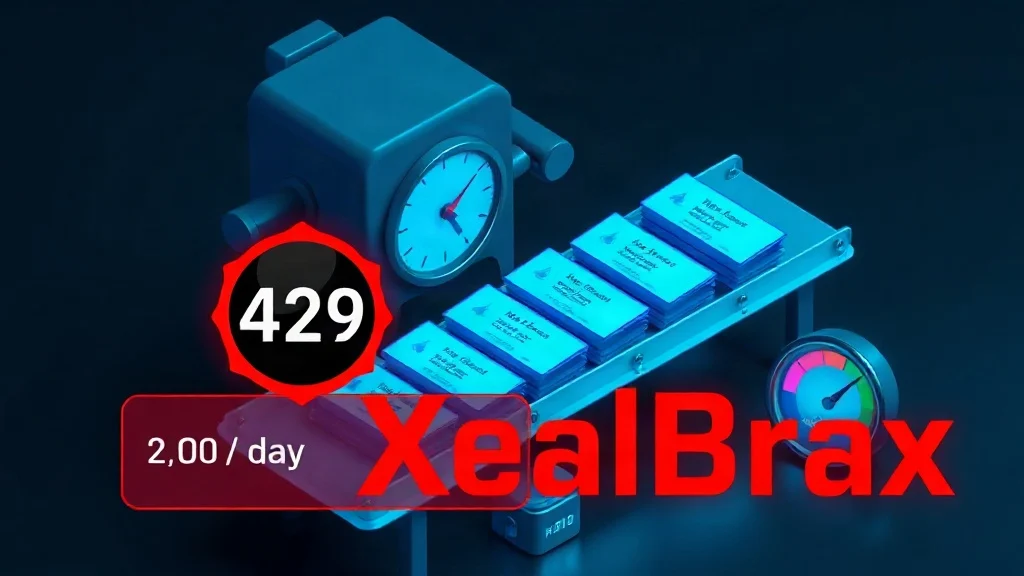
Bulk publishing feels productive right up until the moment Google’s Indexing API begins answering with HTTP 429 and the phrase “Quota Exceeded.” Then the workflow that was supposed to accelerate your content rollout becomes the thing that freezes it , and, in the worst cases, taints the service account behind it. We have watched publishers burn a full day’s request budget in under ten minutes, then discover the real damage hours later when nothing on the site moves in search.
A 429 is not a bug you can brute-force. It is a signal about the shape of your traffic. This masterclass diagnoses the mechanics behind the error, explains why naive retries escalate from throttling into credential risk, and lays out the structural fix: replacing burst submission with a paced, queue-based indexing pipeline that never asks Google for more than it is willing to give.
The Anatomy of a 429: It Is a Shape Problem, Not a Speed Problem
The Google Indexing API accepts one URL per request. There is no batching, no bulk endpoint, no compression. That single design fact is what breaks most publishing workflows, because every URL you want Google to know about is its own HTTP round trip drawing down a shared, per-project daily allowance.
When you cross the ceiling, Google does not politely queue your overflow and get to it later. It rejects each excess request with a 429 and expects the client to wait. A well-behaved client reads that signal, backs off, and resumes. A naive plugin loop reads nothing: it retries instantly, receives another 429, retries again, and converts one over-budget request into five or ten. The budget never recovers, because you are now spending tomorrow’s allowance on retrying yesterday’s failure.
Under the hood, two ceilings operate simultaneously: a daily quota and a short-window rate limit. The daily quota is the number everyone watches. The rate limit is the one people trip over without noticing, because it punishes burstiness. Hundreds of requests fired in a few seconds can fail on a day when you still have most of your budget intact. If you have ever received a 429 while your counter looked healthy, you have met the rate limiter. Google documents the request model and error semantics in its Indexing API quickstart, and reading it once is worth more than a week of trial and error.
The Daily Ceiling vs. the Real Cost of a Single Post
The published daily limit , the 2,000-request figure most publishers work within , sounds generous until you calculate what a bulk operation actually costs per URL. Three multipliers quietly inflate every number:
1. Duplicate hooks. A site running Rank Math’s instant indexing alongside a Yoast snippet, a theme function, and a custom publish hook can fire three or four separate API calls for the same post. One publish, four requests, one indexed URL.
2. Retry storms. Unmanaged retries are the interest rate on your quota debt. A 3x retry loop on a failed batch multiplies consumption by three without producing a single successful submission.
3. Anxiety re-pings. Publishers who cannot see whether a URL landed will often re-push the entire catalogue days later. Those re-submissions consume budget and tell Google nothing it did not already know.
Run the arithmetic on a realistic migration: a 5,000-post import with a single hook and a 2x retry rate consumes roughly 10,000 requests. That is five days of quota spent in an afternoon, and the job is still not finished.
Why Repeated 429s Become Credential Risk, Not Just Slowdowns
Throttling and suspension are not the same consequence, but they sit on the same ladder. Every unhandled 429 that is followed by an immediate retry looks, from Google’s side, like a client ignoring instructions. Do that at scale, repeatedly, and you are building a history that will follow the project , most painfully when you request a quota increase and have to explain why the current allowance was exhausted within minutes.
The blast radius is larger than most teams realise. Most instant-indexing plugins store a single service account or API key in site settings. Agencies frequently reuse one key across every client site because provisioning per-site credentials is tedious. That means a service account that misbehaves on one aggressive import can degrade notification for an entire portfolio at once. In the same way that we advise never sharing a Search Console property casually, we advise never sharing an Indexing API credential across unrelated properties without understanding who else is drawing on that budget.
Your publish hook should never talk to Google directly. XealBrax replaces synchronous submit-on-publish with a smart background queue that drip-feeds URLs on a fixed cadence, keeping every burst far below the rate limiter and leaving your daily quota intact.
Explore Rank Math Instant Indexing Alternative | XealBrax Auto Indexer
The Structural Fix: Pace the Queue, Not the Publisher
The reason bulk publishing fails is architectural. Tools like Rank Math Instant Indexing are built around an event: the moment a post publishes, the plugin fires a request. That model works beautifully for one post a day and collapses for three hundred. Nothing about the API needs to change; the trigger needs to change.
The correct pattern separates four concerns that instant-indexing plugins fuse together:
Capture. The publish event writes a job into a persistent queue. That write is local and instant, so publishing never blocks on a network call and a Google outage can never stall your editorial workflow.
Deduplicate. Before a job enters the queue, the system checks a ledger of URLs already submitted and their status. A post edited four times generates one submission, not four.
Pace. A worker drains the queue on a timer rather than on demand. XealBrax runs this sweep every 15 minutes, which produces small, human-shaped request bursts that sit comfortably inside both the rate limiter and the daily allowance. A 5,000-URL import does not disappear instantly , it drains steadily and predictably, without a single 429.
Verify. Successful submission is acknowledgement, not indexing. The queue records what was accepted, then checks the real outcome separately.
The mental shift is this: the API is a fragile, rationed resource, and your publishing workflow should treat it the way a responsible team treats any rate-limited dependency , asynchronously, with backoff, and with visibility.
A Step-by-Step Quota-Safe Bulk Publishing Workflow
Step 1 , Inventory every hook. Disable instant indexing in Rank Math, Yoast, and SEOPress, then grep your theme and snippets for direct API calls. One submitter per site, or none of the maths below holds.
Step 2 , Build a submission ledger. Every URL should carry a state: queued, sent, accepted, indexed, failed. Without this, deduplication is guesswork and your quota leaks silently.
Step 3 , Decouple publish from request. The publish hook writes to the queue and returns. The API call happens on a schedule, in the background, where a failure costs nothing.
Step 4 , Set a cadence floor, not a target. Choose an interval that makes bursting structurally impossible , a 15-minute drip is the conservative, ban-resistant default. Prefer slightly slow over slightly aggressive; the queue absorbs the delay.
Step 5 , Cap retries with exponential backoff. Three attempts maximum, with growing delays. Anything that fails three times should land in a visible failure list for human review, not a silent loop.
Step 6 , Reserve a priority lane. A time-sensitive article still deserves an immediate push. A manual editor button that jumps the queue costs one request and preserves the cadence for everything else.
Step 7 , Verify with Search Console, never with re-pings. Confirming indexing is a read operation. Re-submitting an already-indexed URL to “check” it is the single most common way publishers waste their daily allowance.
Three Failure Modes We See Repeatedly
Case study one , the migration hangover. A publisher moves 4,200 archived posts to a new domain and re-publishes them to refresh timestamps. Rank Math’s instant indexing fires on each save event, often twice per post thanks to revisions. Roughly 8,400 requests hit the API in under fifteen minutes. The first 2,000 succeed, the rest 429, and an impatient support ticket later, a colleague has written a retry loop that hammers the endpoint for an hour. The queue fix would have drained the same 4,200 URLs over roughly a day and a half with zero rejections.
Case study two , the shared agency credential. An agency manages 30 client sites, all pointing at one service account. Publishing days on three clients overlap, and each believes it owns the full allowance. Nobody can explain why the smallest client suddenly cannot get a new product page noticed. Per-site pacing plus a visible quota tracker would have made the collision obvious before it happened.
Case study three , the content factory. An operation running an AI auto blogging engine publishes 300 posts a day across a network. The generation and the indexing are both automated, so 429s are guaranteed without an intermediary queue , and nobody is watching at 3 a.m. when the failures start. Pacing is the only reason a high-volume network stays inside its allowance.
Instrumentation: What You Must Be Able to See
You cannot manage a rationed resource you cannot observe. Before trusting any indexing workflow, insist on five visible signals: a queue dashboard showing what is pending and when the next tick fires; a running count against the daily limit so you know how much headroom remains; per-URL status badges so an editor can answer “did this post reach Google?” without opening a console; a verification layer that confirms actual indexing rather than mere submission acceptance; and automated monitoring of unindexed URLs that opens a request only when one is genuinely needed.
That is precisely the governance layer we built into the Pro tier of XealBrax Auto Indexer: countdown timers on the queue, a visual quota tracker against the daily ceiling, live Search Console indexing checks, daily auto-monitoring of stubborn URLs, and automated 404 removal requests so stale pages stop consuming attention. The plugin stays under 100KB, runs on native PHP OpenSSL, and sits alongside Yoast, Rank Math, or SEOPress rather than fighting them for the publish hook.
Stop trading quota for speed. Instant pings on publish, a manual editor push, and a background queue that drip-feeds every 15 minutes give you indexing velocity that never triggers a 429 , and never puts your API key at risk.
Explore Rank Math Instant Indexing Alternative | XealBrax Auto Indexer
The Bottom Line
A 429 during bulk publishing is not an inconvenience to be retried away , it is proof that your submission model is event-driven in a world that demands pacing. Fix the trigger, add a ledger, drip the queue, and verify the outcome. The publishers who index fastest at scale are never the ones firing the most requests; they are the ones whose requests are never wasted.
FAQ
Does a single 429 error permanently ban my Indexing API key?
No. A 429 is a throttling response, not a revocation. Risk accumulates from patterns , sustained retry loops that ignore the signal, or repeated exhaustion of a project’s allowance. Back off properly, pace your submissions, and you stay well clear of suspension territory.
How many URLs can I realistically index per day?
Most publishers work within a 2,000-request daily ceiling, minus anything already consumed by retries or duplicates. Because the API takes one URL per request, budget realistically: a 15-minute drip cadence keeps bursts small and leaves headroom for manual priority pushes on time-sensitive content.
Can I just keep using Rank Math Instant Indexing for large imports?
You can, but it fires synchronously on the publish hook with no pacing or queue, which is exactly how 429 storms begin on a 5,000-post import. If you want the same publish-time convenience with a background drip-feed, quota tracking, and verification built around it, a dedicated indexing queue is the safer architecture.

A Personal Note From Collins E. Iyorah, Founder of XealBrax
I built XealBrax because creators, bloggers, and small businesses shouldn’t have to piece together fragmented tools to grow online. Whether you are optimizing your website performance, utilizing our AI-driven utilities, or scaling through our Creator Network, our goal is to give you a transparent, penalty-free path to digital success. If you want a complete look at how we help brands scale, read my personal guide to get started.