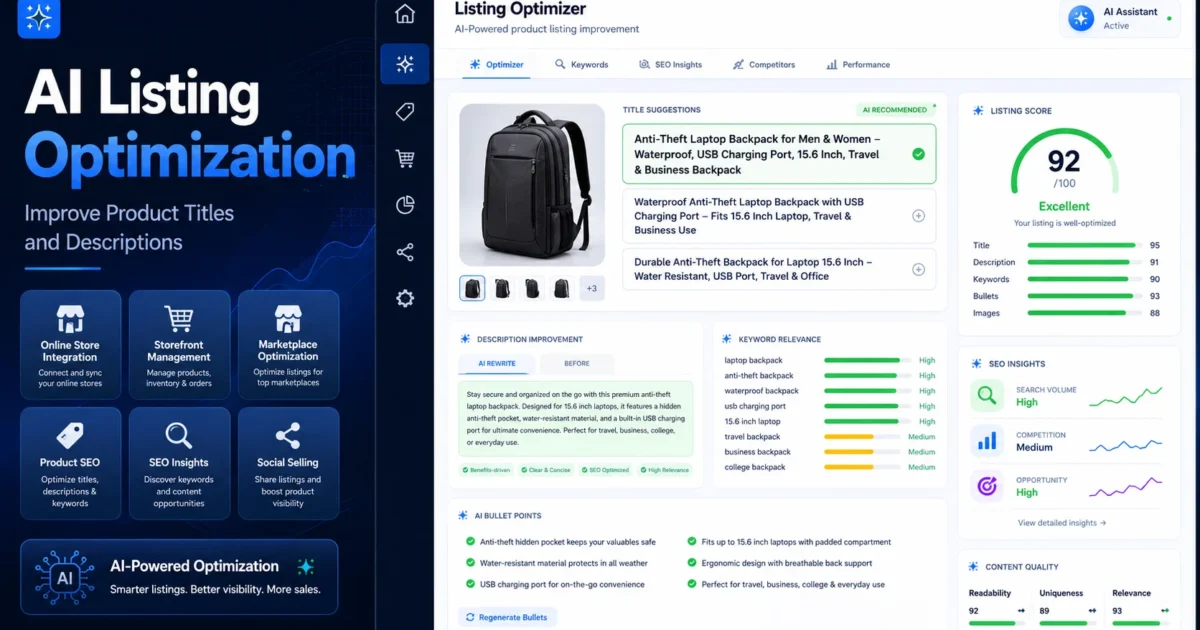
AI listing optimization helps you improve product titles, descriptions, bullet points, keywords, and product page clarity so buyers and search systems can understand what you sell faster. If your product title is vague, your description is thin, or your listing misses important details like size, color, material, benefits, availability, or delivery information, your product may struggle to get attention.
This guide explains how AI listing optimization works, what a strong product listing should include, how to improve product titles and descriptions, and how to use the XealBrax Product Listing Optimizer to create clearer listings for online stores, marketplaces, WooCommerce, Shopify, and social selling pages.
Start here: Use the free XealBrax Product Listing Optimizer to improve product titles, descriptions, bullet points, benefits, and listing clarity before publishing.
“`
“`
AI Listing Optimization: What It Means for Product Pages
AI listing optimization is the process of using artificial intelligence to improve product listing content. This can include product titles, descriptions, bullet points, keywords, product benefits, category language, image ALT text ideas, and sales copy.
The goal is not to create fake hype or stuff keywords into every sentence. The goal is to make the product easier to understand, easier to compare, and easier to find.
A good AI listing optimization workflow helps you answer important product questions:
- What exactly is the product?
- Who is it for?
- What problem does it solve?
- What are the key product details?
- What makes it useful or different?
- What keywords or buyer phrases should appear naturally?
- What should a buyer know before purchasing?
Why Product Listings Need Optimization
Many product listings fail because they are unclear. The product may be good, but the listing does not explain the product properly. Buyers may not understand the size, use case, material, key benefit, delivery details, or reason to choose it.
Search systems also need clear product information. E-commerce platforms, marketplaces, search engines, and social commerce pages all rely on product data to understand what the item is and where it may be relevant.
Google’s ecommerce SEO documentation explains that e-commerce websites should help Google understand product pages, product data, and site structure. Product content, structured data, images, and clear page details all support better product discoverability.
Common product listing problems
- Vague product title.
- Missing product details.
- Thin product description.
- No useful bullet points.
- No clear product benefit.
- Keyword stuffing.
- Poor image ALT text.
- Missing size, color, material, or compatibility details.
- Unclear price, availability, or delivery information.
- No trust signals such as reviews, returns, or support information.
What Product Titles Should Include
A product title should quickly explain what the product is. It should include the most useful product details without becoming unreadable.
A strong product title usually includes the product type, main keyword, brand or collection if relevant, key feature, size, color, material, use case, or buyer-specific detail.
Useful product title elements
- Product type: shoes, handbag, phone case, laptop stand, skincare set.
- Primary keyword: the main phrase buyers may search for.
- Brand or collection: if relevant and accurate.
- Material: leather, cotton, stainless steel, ceramic, silicone.
- Size or capacity: 500ml, 13-inch, XL, 2-pack.
- Color: black, white, navy, gold, transparent.
- Use case: office, travel, gym, daily wear, gifting.
- Key benefit: lightweight, waterproof, adjustable, breathable.
Weak product title
Nice Bag
Better product title
Women’s Black Leather Crossbody Bag with Adjustable Strap for Daily Use
Quick Tip
A product title should be specific enough to help the buyer understand the item, but natural enough to read like a real product name.
How to Write Better Product Descriptions
A product description should explain what the product is, what it does, who it is for, and why it is useful. It should not only repeat the title.
A strong description gives buyers the missing context they need before making a decision. This is especially important for online stores and marketplaces where buyers cannot physically inspect the product.
A good product description should include:
- A clear opening sentence that describes the product.
- The main benefit or use case.
- Important product features.
- Size, color, material, or compatibility details.
- Who the product is best for.
- How the product can be used.
- Care, delivery, or availability details where relevant.
- A clear call to action if the platform allows it.
Weak product description
This is a nice quality product. Buy now. Available in different colors.
Better product description
This adjustable laptop stand helps improve desk posture by raising your laptop screen to a more comfortable viewing height. It is lightweight, foldable, and suitable for home offices, students, freelancers, and remote workers who need a simple desk setup upgrade.
How AI Helps Improve Product Listings
AI can speed up the listing improvement process by turning rough product information into clearer titles, descriptions, bullet points, benefit statements, and keyword-rich copy.
This is especially useful when you have many products to upload or when you are starting from supplier descriptions that are too short, generic, or duplicated.
AI can help with:
- Generating product title variations.
- Improving weak product descriptions.
- Turning product features into buyer benefits.
- Creating bullet points for easier scanning.
- Suggesting natural keywords.
- Improving clarity for marketplace listings.
- Creating image ALT text ideas.
- Adapting copy for Shopify, WooCommerce, marketplaces, and social sellers.
Useful tool: Use the XealBrax Product Listing Optimizer to generate stronger product titles, descriptions, bullet points, and product listing copy.
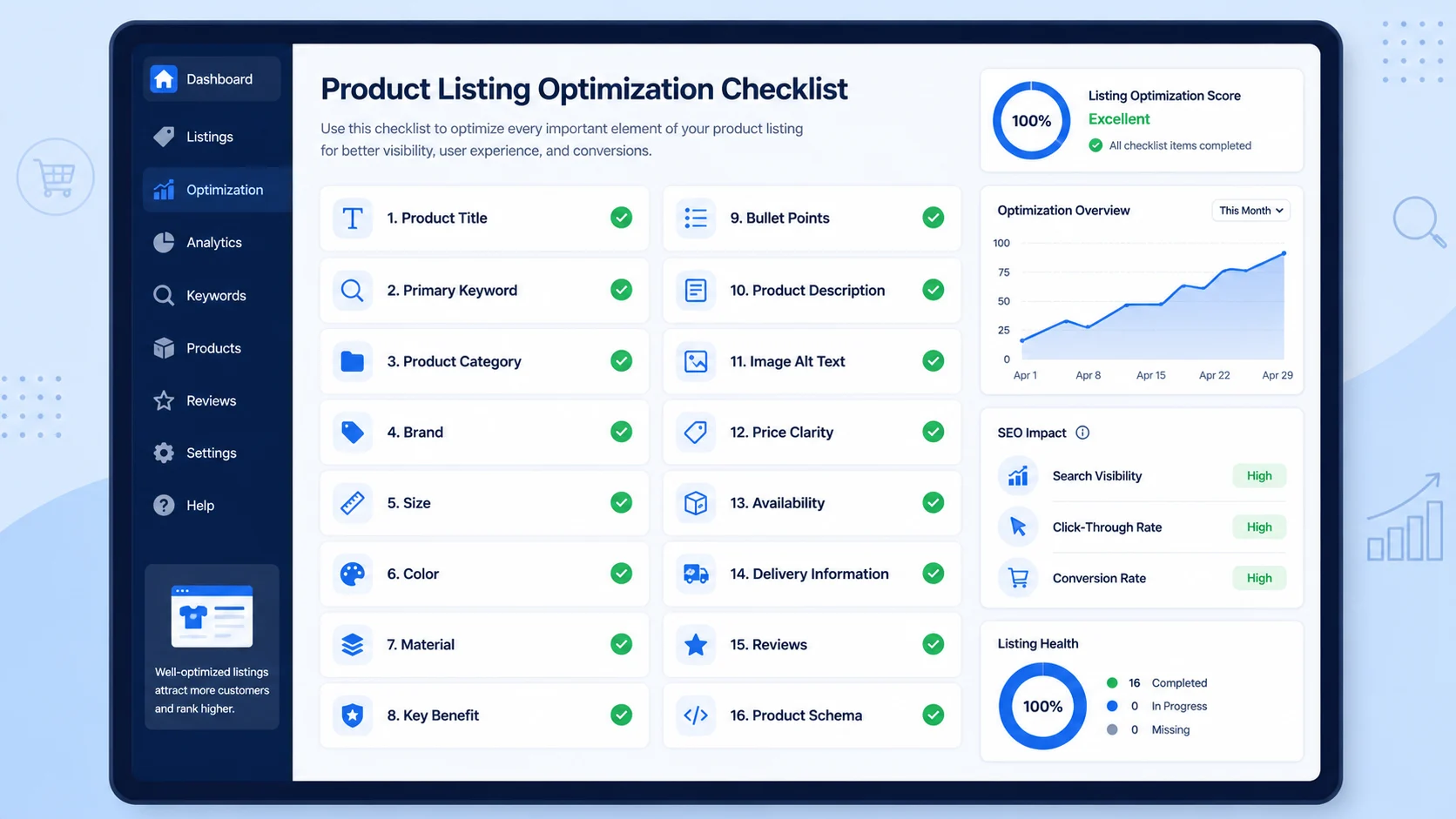
Product Listing Optimization Checklist
Use this checklist before publishing or updating a product page. It works for online stores, product landing pages, marketplaces, WooCommerce, Shopify, and social selling pages.
- Product title: clear, specific, and buyer-friendly.
- Primary keyword: included naturally in the title or description.
- Category: correct product category or collection.
- Brand: included only when accurate and useful.
- Size: clear measurements, capacity, dimensions, or fit.
- Color: accurate color name where relevant.
- Material: clearly stated when important.
- Key benefit: what the product helps the buyer do.
- Bullet points: quick scan-friendly feature and benefit points.
- Description: clear explanation of product use and value.
- Image ALT text: descriptive text for product images.
- Price clarity: visible and easy to understand.
- Availability: in stock, out of stock, pre-order, or limited availability.
- Delivery information: shipping, pickup, or delivery details where relevant.
- Reviews or trust signals: when available and genuine.
- Product schema: structured data where supported by visible product details.
Weak vs Optimized Product Listing Example
A weak product listing makes the buyer work too hard. An optimized listing gives the buyer useful information quickly.
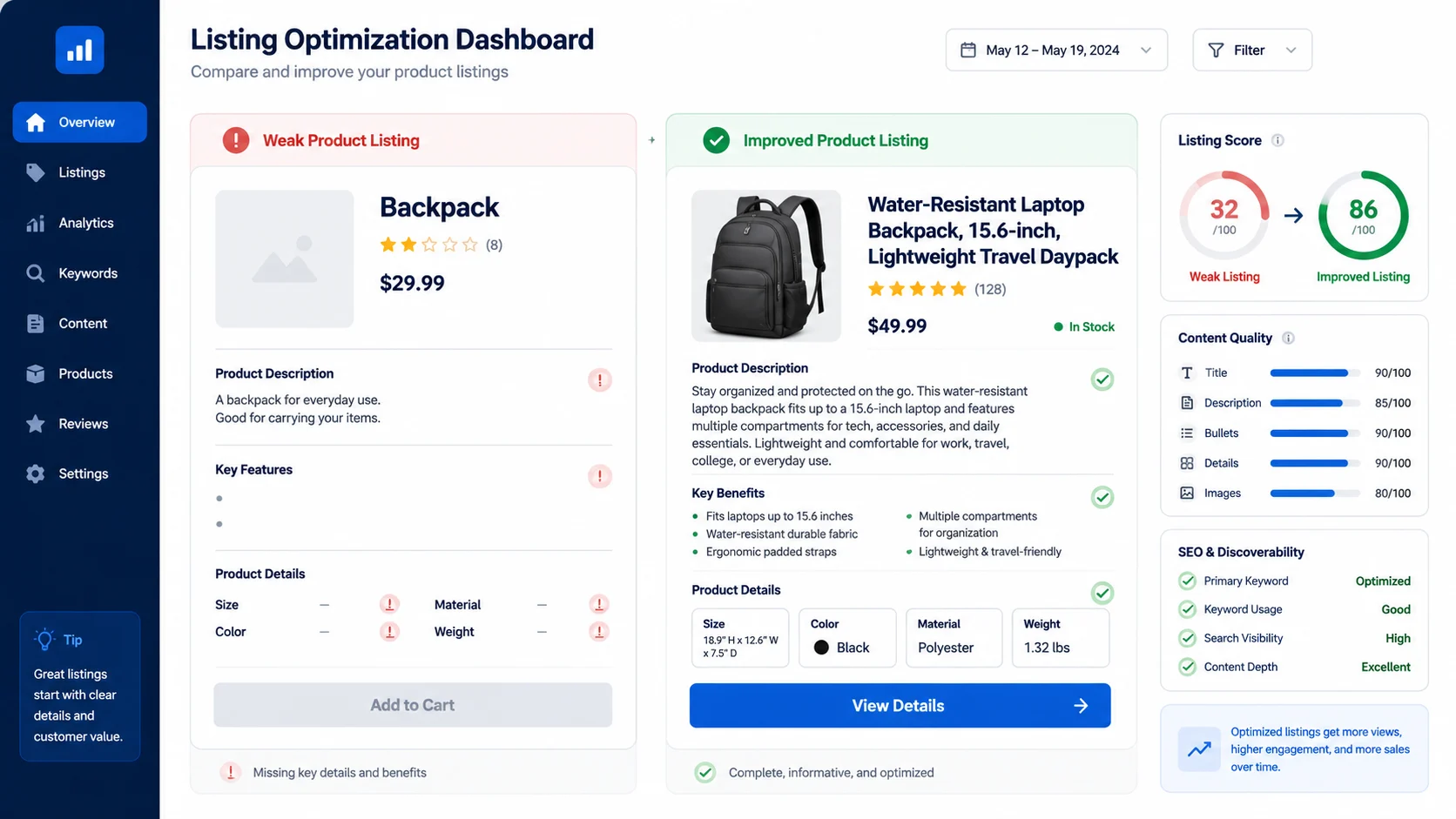
Weak listing
Title: Nice Office Chair
Description: Good chair for office and home. Comfortable and strong. Buy now.
Optimized listing
Title: Ergonomic Black Office Chair with Adjustable Height and Lumbar Support
Description: This ergonomic black office chair is designed for home offices, students, remote workers, and business workspaces. It includes adjustable height, padded seating, lumbar support, and smooth-rolling wheels for daily desk use.
- Adjustable height for different desk setups.
- Lumbar support for improved sitting comfort.
- Black finish suitable for office and home use.
- Smooth wheels for easy movement.
- Best for remote workers, students, and business spaces.
Improve Your Product Listing With AI
Use the XealBrax Product Listing Optimizer to improve product titles, descriptions, bullet points, benefits, and listing clarity before publishing.
How to Use the XealBrax Product Listing Optimizer
The XealBrax Product Listing Optimizer helps you turn rough product details into clearer product listing copy. It is useful for sellers, small businesses, online stores, creators, dropshipping pages, marketplace vendors, and e-commerce teams.
- Enter your product details: include product type, category, size, color, material, features, and target buyer.
- Add the current title or description: paste the weak version if you already have one.
- Generate improved copy: create title ideas, bullet points, descriptions, and benefit-focused wording.
- Review the output: check accuracy, product facts, tone, and platform rules.
- Edit for your store: adjust the final copy for Shopify, WooCommerce, marketplace, or social selling use.
- Publish with better product details: add images, availability, delivery information, and trust signals.
If you are also creating SEO titles and meta descriptions for product pages, use the XealBrax Meta Tag Generator. If you want to check technical SEO and page issues, use the free SEO Audit Tool.
Shopify, WooCommerce, Marketplaces, and Social Selling
AI listing optimization can support different selling channels, but each channel has its own needs.
Shopify stores
Shopify sellers should focus on clear product titles, product descriptions, collection structure, image ALT text, SEO title, meta description, and product page clarity.
WooCommerce stores
WooCommerce sellers should review product names, short descriptions, long descriptions, product categories, tags, image ALT text, product schema, and page speed.
Marketplaces
Marketplace sellers should follow the platform’s title and description rules carefully. Some platforms have strict policies about promotional language, keyword stuffing, special characters, or unsupported claims.
Social selling pages
Social sellers on Instagram, TikTok, Facebook, WhatsApp, and similar channels need product copy that is clear, short, and easy to act on. A strong listing should include the product name, key benefit, price clarity, delivery details, and how to order.
Nigerian online vendors and small businesses
Nigerian sellers often sell across multiple channels at once, including Instagram, WhatsApp, marketplaces, and personal websites. AI listing optimization can help create cleaner product copy that works across these channels while still keeping the language simple and practical.
Common Product Listing Mistakes to Avoid
AI can improve product listings quickly, but the final version should still be checked before publishing. Avoid these common mistakes.
1. Keyword stuffing
Do not repeat the same keyword unnaturally. Product titles and descriptions should be readable.
2. Missing product details
Buyers need details such as size, color, material, compatibility, quantity, delivery, and use case.
3. Overpromising
Avoid unrealistic claims, fake urgency, fake discounts, or unsupported performance claims.
4. Copying supplier descriptions
Supplier descriptions are often generic. Rewrite them to match your buyer, brand, and channel.
5. Ignoring images
Product images, image names, ALT text, and captions can help buyers understand the product faster.
6. Forgetting mobile users
Many buyers browse on mobile. Product information should be easy to scan on small screens.
Product SEO and Structured Data Basics
Product SEO is not only about writing better titles and descriptions. Product pages also need clear product data, useful images, crawlable content, and structured information where supported.
Google’s product structured data documentation explains that structured data can help Google understand product information such as price, availability, ratings, and product details. Google also notes that product pages and Merchant Center feeds can work together to support product experiences where eligible.
Product data to keep accurate
- Product name.
- Product image.
- Description.
- Price.
- Availability.
- Brand where applicable.
- SKU or product identifier where applicable.
- Reviews or ratings where genuine and visible.
Important Note
Do not add product schema for details that are not visible or accurate on the page. Product structured data should match the real product information shown to users.
Recommended AI Listing Optimization Workflow
Use this workflow whenever you publish or update a product listing:
- Collect product facts: product type, category, brand, size, color, material, features, benefits, price, availability, and delivery information.
- Identify the buyer: who needs the product and why.
- Generate title ideas: use AI to create clear product title options.
- Improve the description: turn weak or supplier copy into useful buyer-focused copy.
- Create bullet points: make the listing easier to scan.
- Review for accuracy: remove unsupported claims or wrong details.
- Add image ALT text: describe product images clearly.
- Set SEO metadata: use the Meta Tag Generator for product page SEO titles and descriptions.
- Check the page: use the SEO Audit Tool to check common technical and on-page issues.
Need help improving your store visibility? XealBrax can support SEO, product listing optimization, WordPress performance, metadata, and visibility strategy.
Helpful Product Listing and E-commerce SEO Resources
For deeper guidance, compare your product listing workflow with trusted ecommerce and product data resources. Google’s ecommerce SEO documentation explains SEO guidance for ecommerce websites. Google’s product structured data documentation explains how product information can be marked up for eligible search experiences. Google Merchant Center’s product data specification provides guidance on product titles, descriptions, and accurate product information.
Use these resources alongside the XealBrax Product Listing Optimizer, the Meta Tag Generator, and the free XealBrax tools page to improve your product pages more carefully.
FAQ: AI Listing Optimization
What is AI listing optimization?
AI listing optimization is the use of artificial intelligence to improve product titles, descriptions, bullet points, keywords, benefits, image ALT text ideas, and product listing clarity for online stores, marketplaces, and social selling pages.
Can AI write product titles and descriptions?
Yes. AI can generate product title and description ideas quickly, but you should review the output manually to make sure the product details are accurate, clear, and suitable for your selling platform.
What should a product title include?
A product title should usually include the product type, main keyword, important feature, size, color, material, brand where relevant, and use case. It should stay readable and avoid keyword stuffing.
How do I optimize product descriptions for SEO?
Start with accurate product facts, explain the product clearly, include natural keywords, describe benefits, add useful details such as size and material, use bullet points where helpful, and avoid exaggerated or unsupported claims.
Can AI listing optimization help Shopify and WooCommerce stores?
Yes. AI listing optimization can help Shopify and WooCommerce sellers improve product names, descriptions, short descriptions, SEO titles, meta descriptions, image ALT text ideas, and product page clarity.
Should I review AI-generated product listings before publishing?
Yes. Always review AI-generated listings before publishing. Check product facts, pricing, claims, size, color, material, delivery information, platform rules, and whether the copy accurately describes the real product.
Optimize Your Next Product Listing
Start with clear product facts, generate stronger listing copy, review the output, and publish product pages that are easier for buyers and search systems to understand.

A Personal Note From Collins E. Iyorah, Founder of XealBrax
I built XealBrax because creators, bloggers, and small businesses shouldn’t have to piece together fragmented tools to grow online. Whether you are optimizing your website performance, utilizing our AI-driven utilities, or scaling through our Creator Network, our goal is to give you a transparent, penalty-free path to digital success. If you want a complete look at how we help brands scale, read my personal guide to get started.