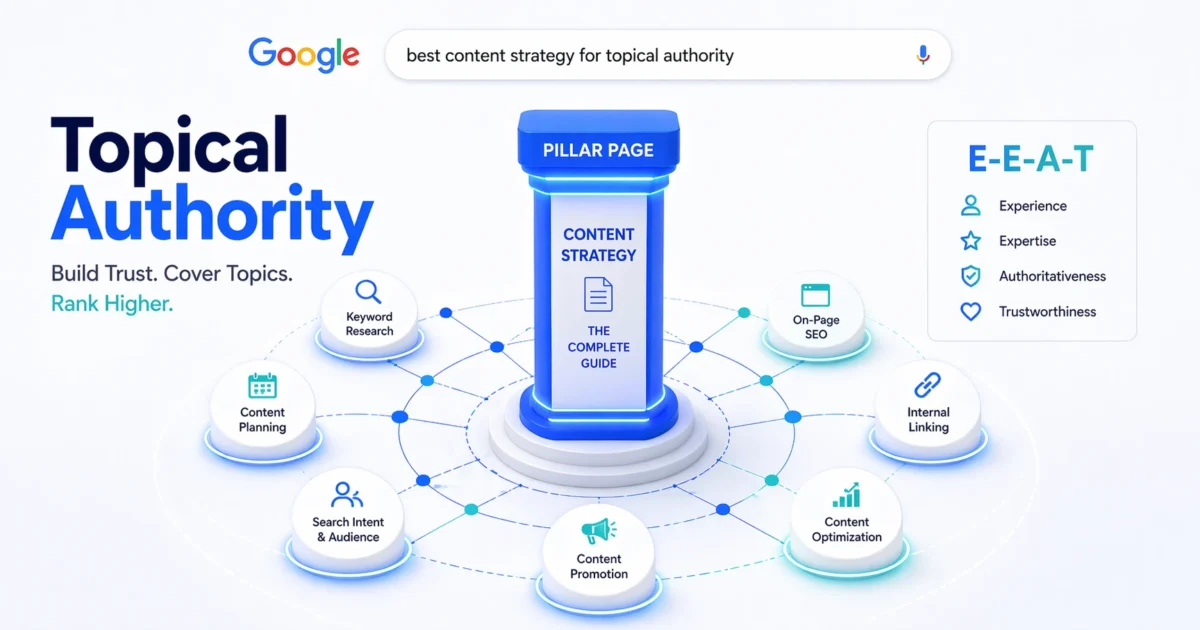
Ranking for competitive keywords in 2026 isn’t just about having the longest article or the most backlinks. Google’s algorithms have matured to reward topical authority—the depth and breadth of expertise your site demonstrates on a subject. You don’t need a blog with 100 posts; you need a smart, interconnected content structure that signals to search engines (and users) that you genuinely own the topic.
In this guide, we’ll break down exactly how to build topical authority using the proven pillar‑cluster model, how to align it with E‑E‑A‑T requirements, and how we applied the same strategy to grow XealBrax’s own Insights hub—without churning out dozens of articles.
What Is Topical Authority (and Why Does Google Care)?
Topical authority means your website is recognized as a credible, comprehensive source on a specific subject area. Instead of ranking signals coming from a single page’s strength, Google evaluates whether your entire site covers a topic with meaningful depth. This shift is driven by the E‑E‑A‑T framework (Experience, Expertise, Authoritativeness, and Trustworthiness), which the March 2026 Core Update reinforced even further.
Imagine two sites: one has a single 5,000‑word article about “WordPress SEO,” while the other has a 1,500‑word main guide, plus separate articles on keyword research, technical setup, schema markup, image optimization, and internal linking—all interlinked. The second site will almost always outrank the first because it demonstrates that the topic is a core competency, not a one‑off post.
The Pillar‑Cluster Model: Your Shortcut to Authority
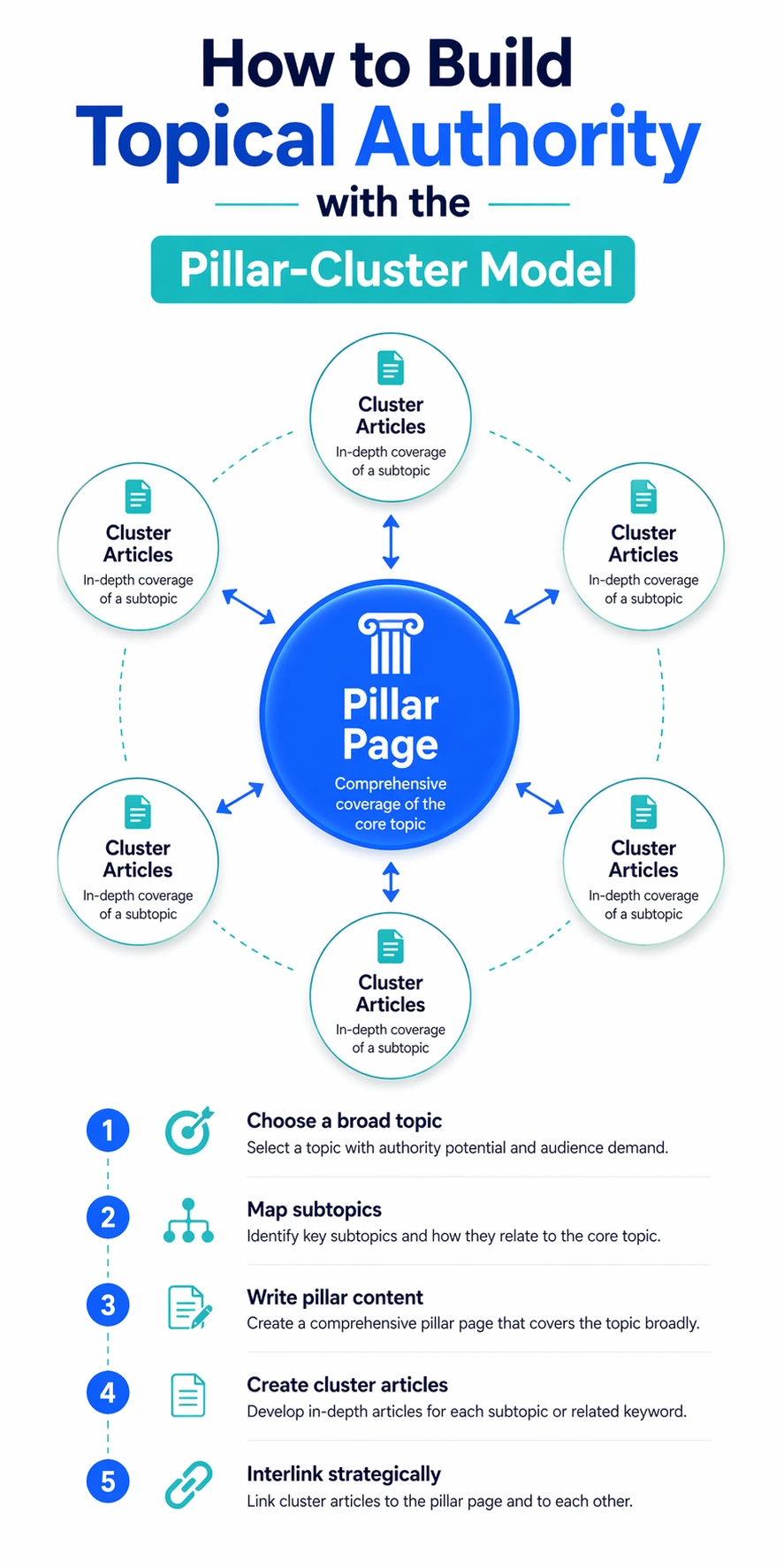
This model organizes content into two layers:
- Pillar Page: A comprehensive, broad resource that covers a core topic at a high level (e.g., “WordPress SEO in 2026: The Ultimate Guide”).
- Cluster Articles: Shorter, focused pieces that dive deep into subtopics mentioned in the pillar page (e.g., “10 WordPress Speed Killers,” “E‑commerce Product Page SEO Checklist”).
Every cluster article links back to the pillar page, and the pillar page links out to the clusters. This internal‑linking structure creates a semantic web that helps search engines understand the relationship between your pages and the topic’s full scope.
Step‑by‑Step: How to Build a Content Cluster in 5 Steps
Step 1: Choose a Broad Topic (Your “Pillar”)
Pick a topic broad enough to support multiple subtopics but specific enough to define a niche. Examples: “WordPress SEO,” “E‑commerce Conversion Optimization,” “Core Web Vitals.” This will be your pillar page—a definitive guide that introduces the topic and touches on every important subtopic.
Step 2: Map Subtopics for Clusters
Brainstorm at least 5–10 subtopics that complement the pillar. These should be questions your audience actually asks or pain points they face. Use tools like Google’s “People Also Ask,” Ahrefs, or even the autocomplete feature to find real queries. For example, “Core Web Vitals” could spawn:
- How to improve LCP on WordPress
- What is INP? A non‑technical guide
- CLS fixes for mobile layouts
- Best caching plugins for Core Web Vitals
- Case study: improving Core Web Vitals scores by 40%
Step 3: Write the Pillar Page First
Create an in‑depth pillar article (1,500–3,000 words). It should be a standalone resource but also naturally introduce each subtopic. Avoid linking to non‑existent pages yet—you can add internal links later as you publish clusters. The pillar should demonstrate genuine expertise: cite data, include examples, and be well‑structured with clear headings.
Step 4: Create Cluster Articles (Don’t Rush)
Publish each cluster article over time. Each should be thorough on its subtopic and include a link back to the pillar page using descriptive anchor text (e.g., “…as explained in our complete WordPress SEO guide“). This reinforces the semantic relationship.
Step 5: Interlink Strategically
Once all cluster articles are live, audit your internal links. The pillar should link to each cluster, and clusters should cross‑link where relevant. Use a tool like Rank Math’s internal link suggestion feature (free) or Link Whisper to automate discovery of linking opportunities.
Real‑World Example: How We Built the XealBrax Insights Hub
We practice what we teach. Our Insights page started with a single pillar guide—WordPress SEO in 2026: The Ultimate Guide to Ranking Higher. Instead of publishing dozens of random posts, we mapped out five core clusters that real clients ask about:
- Page speed and Core Web Vitals (e.g., our 10 Speed Killers article)
- E‑commerce product page optimization
- SEO plugin comparisons and setup
- Content strategy and topical authority (you’re reading it now)
- Free tools and audits to support each cluster
Each cluster links back to the pillar and to related articles. The result? Within weeks, organic traffic began climbing not just for individual long‑tail keywords but for broader competitive terms. Google recognized that our site wasn’t a one‑hit wonder—it had depth.
You can replicate this structure for any niche. Start with one pillar, three to five clusters, and a consistent internal‑linking pattern. It’s more effective (and manageable) than attempting to publish 100 standalone posts.
🛠️ Don’t forget to check out our free SEO and performance tools – they’ll help you audit your site, find content gaps, and track your progress as you build topical authority.
Tools to Map Keywords and Internal Links
You don’t need expensive enterprise software to build clusters. Here’s what we use and recommend:
- Google Keyword Planner – free, basic keyword volumes and suggestions.
- Ahrefs / Semrush – identify content gaps and see what competitors rank for.
- Rank Math (free) – built‑in Google Search Console integration reveals which queries your pages already rank for, perfect for finding cluster opportunities.
- AlsoAsked.com – visualizes “People Also Ask” data to reveal subtopic ideas.
- Link Whisper – automatically suggests internal links as you write.
- Google Search Console – see which queries trigger impressions but lack clicks; these are candidates for new cluster articles.
Common Mistakes to Avoid
- Pillar pages that are too thin. A 500‑word overview won’t cut it. Pillars must deliver standalone value.
- Cluster articles that don’t link back. The entire model collapses without internal links.
- Creating clusters on unrelated topics. Every cluster must tie logically to the pillar; otherwise, you dilute authority.
- Ignoring updates. Topical authority requires freshness—periodically refresh pillar and cluster content.
Start Small, Think Big
You don’t need a massive content budget. One well‑constructed pillar with five strong cluster articles will outperform 30 scattered, unrelated posts. Focus on depth within a defined topic area, and you’ll build the kind of authority that Google rewards—and that your audience trusts.
Need help mapping out your content clusters? Book a strategy call and we’ll help you define your pillar topics, map subtopics, and build a sustainable content plan—starting from $50.

A Personal Note From Collins E. Iyorah, Founder of XealBrax
I built XealBrax because creators, bloggers, and small businesses shouldn’t have to piece together fragmented tools to grow online. Whether you are optimizing your website performance, utilizing our AI-driven utilities, or scaling through our Creator Network, our goal is to give you a transparent, penalty-free path to digital success. If you want a complete look at how we help brands scale, read my personal guide to get started.